
Understanding Different Bone Break Patterns and Their Implications
Every fracture has a story. Some are simple cracks that heal quietly with rest, while others are complex injuries that demand surgical care and rehabilitation.
To help doctors diagnose and treat them accurately, fractures are classified based on three main criteria:
This classification helps identify not only how the bone broke but also why it happened and what kind of treatment and recovery will be required.
By understanding these categories, patients and caregivers can recognise the different ways fractures occur and how each type affects healing.
A clean break that runs horizontally across the bone. It usually occurs after a strong, direct blow, such as falling on an outstretched limb.
This fracture runs diagonally across the bone. It commonly results from a twisting injury, like slipping while turning quickly or twisting the leg during a fall.
A vertical break that travels along the length of the bone. These are less common but may occur in long bones like the tibia (shin bone) after heavy stress or impact.
A twisting force causes the bone to break in a spiral pattern, wrapping around its shaft. It's often seen in sports injuries or accidents involving rotating force, such as slipping on uneven ground.
Here, the bone shatters into three or more pieces due to severe trauma, such as a road accident. Because of its complexity, surgical fixation is usually required for proper alignment.
Two distinct breaks occur in the same bone, leaving a "floating" segment between them. These are serious fractures that typically require stabilisation with metal implants.
Seen mainly in children, this is a partial bend and crack rather than a complete break. The bone's flexibility prevents a full separation, allowing quicker healing with proper immobilisation.
A tiny crack that develops gradually from repetitive force or overuse. Common in runners, soldiers, and athletes, these fractures often appear in the feet, shins, or hips and can be missed without imaging.
Occurs when a small piece of bone is pulled away by a tendon or ligament during sudden movement. Sports that involve sprinting or jumping, such as football or basketball, frequently cause avulsion fractures.
Instead of breaking completely, one side of the bone compresses and bulges outward. This injury is common in children due to their softer bones and generally heals well with supportive casting.

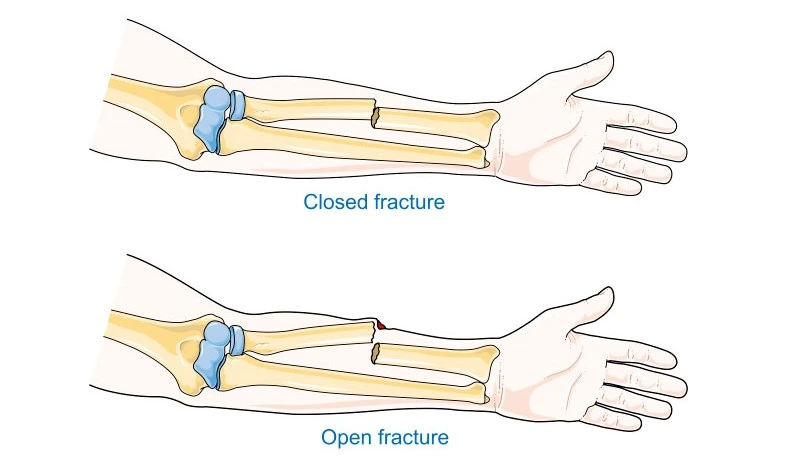
In these cases, the broken bone pierces through the skin, creating a visible wound. These injuries carry a higher risk of infection and often need urgent surgical cleaning and fixation.
The bone breaks internally without cutting through the skin. Though less prone to infection, it still requires immobilisation and medical supervision for proper healing.
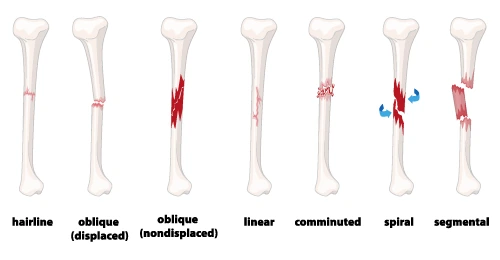
The bone ends move out of alignment, creating a visible deformity or gap at the fracture site. Surgery or metal implants may be required to realign the bone.
The bone cracks but remains in its normal position. Such fractures often heal with casting, rest, and gradual physiotherapy.
Stable, non-displaced fractures heal the fastest, usually within six to eight weeks, provided bone health and nutrition are adequate.
Ageing bones lose density and strength, especially after menopause or in osteoporosis, making them more prone to breaks even after minor falls.
Yes, most stress fractures heal with rest and activity modification, but diagnosis by a doctor is essential to prevent worsening.
They can become serious due to infection risk and blood loss. Immediate medical care is necessary.
X-rays are the first step, followed by CT or MRI scans in complex cases. Read more on Fracture Diagnosis.